How to Evaluate a Rutile Sand Supplier Before Long-Term Cooperation
Choosing a rutile sand supplier for one trial order is relatively simple. Building a stable, long-term supply relationship is much more demanding.
For welding electrode manufacturers, rutile sand is not just another mineral raw material. Its chemical composition, particle size distribution, moisture level and batch consistency can directly affect coating preparation, extrusion performance, arc stability, slag behavior and the appearance of the finished weld.
A supplier offering an attractive price may be suitable for a small test order, but long-term cooperation requires a broader evaluation. Buyers need to understand not only what the supplier can deliver today, but also whether the same quality can be supplied consistently over the following months and years.
Below are the main points welding electrode manufacturers should check before approving a rutile sand supplier for regular purchasing.
1. Check Whether the Specification Matches the Actual Application
The first step is to confirm that the proposed rutile sand specification is suitable for your electrode formulation and production process.
Two materials may both be described as 95% rutile sand, but their actual performance can still be different. Buyers should check the complete chemical composition instead of focusing only on the TiO2 content.
Important parameters normally include:
TiO2 content
SiO2 content
Total iron content
ZrO2 content
Phosphorus and sulfur
Moisture
Particle size distribution
The acceptable specification depends on the electrode type, coating formulation and manufacturing equipment. A higher TiO2 value does not automatically mean that the material will perform better in every recipe.
Before discussing annual prices or long-term contracts, the buyer and supplier should clearly agree on the required specification, testing method and acceptable tolerance.
2. Evaluate Batch-to-Batch Consistency
One successful sample does not prove that every future shipment will have the same quality.
Batch consistency is one of the most important factors in long-term rutile sand purchasing. If the chemical composition or particle size changes significantly between shipments, the electrode manufacturer may need to adjust the coating formulation, binder addition or extrusion parameters.
This creates additional production work and may lead to unstable electrode performance.
When evaluating a supplier, buyers should ask:
Does the supplier test every production batch?
What tolerances are normally controlled?
Can the supplier provide COAs from several recent batches?
How is material blended before packing?
How does the supplier control variation in raw mineral feed?
A reliable supplier should be able to explain how raw materials are selected, processed, screened, blended and inspected. The supplier should also be willing to provide representative batch data rather than only one especially good test report.
3. Confirm That the COA Represents the Delivered Batch
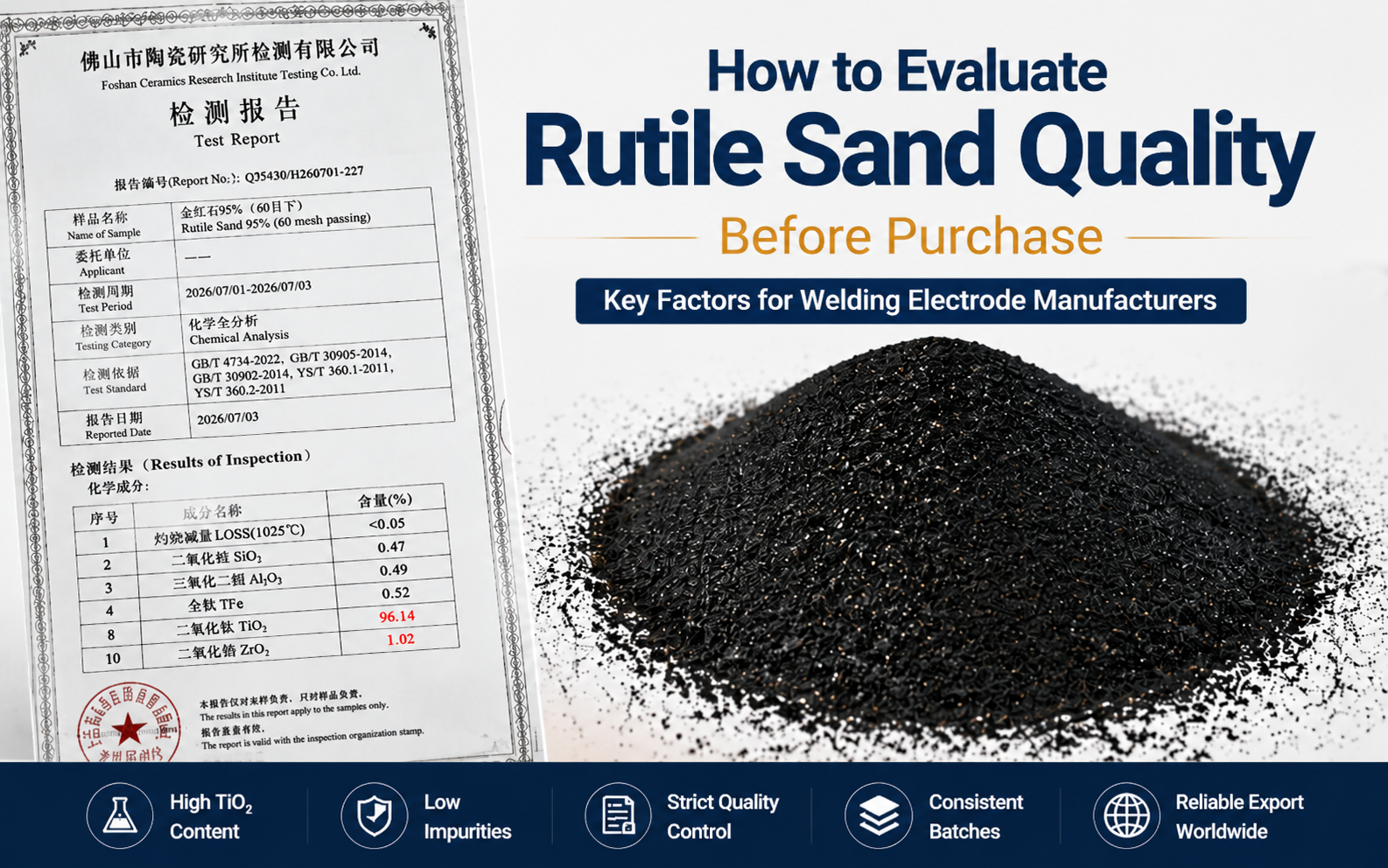
A Certificate of Analysis is an important purchasing document, but buyers should confirm that it corresponds to the actual batch being supplied.
A useful COA should contain:
Product name and grade
Batch or lot number
Production or test date
Chemical analysis
Particle size information
Moisture result, when required
Testing method or inspection reference
For a new supplier, it is reasonable to compare the supplier's internal COA with an independent laboratory result. Small differences may occur because of sampling and testing methods, but major differences should be investigated before a commercial order is placed.
Buyers can also review our article Rutile Sand COA: What Buyers Should Check Before Placing an Order for a more detailed explanation of the key items on a rutile sand test report.
4. Pay Attention to Particle Size Distribution
Particle size has a major influence on the behavior of rutile sand in electrode coating production.
It is not enough for a supplier to state only that the material is “60 mesh” or “200 mesh.” Buyers should understand whether this refers to full passing, retained material or the main particle size range.
A suitable particle size distribution may help improve:
Dry mixing uniformity
Coating surface quality
Extrusion stability
Binder distribution
Drying performance
Arc and slag consistency
Too many coarse particles may affect coating smoothness or create unstable extrusion. Excessive fine material may increase water demand, change coating viscosity or create difficulties during drying.
Before approving a supplier, buyers should request a sieve analysis and test the material under actual production conditions. For more information, see How Particle Size Distribution Affects Rutile Sand Performance in Welding Electrodes.
5. Understand the Supplier's Processing Capability
A trading company can still be a reliable supplier, but buyers should understand who controls the processing and quality inspection.
Important questions include:
Where is the raw mineral sourced?
Where is the material processed?
Who controls crushing, screening and blending?
Can the supplier adjust particle size?
How is contamination prevented?
What is the normal monthly production capacity?
A supplier with direct access to processing and inspection normally has better control over particle size, blending and final packing. It may also be easier for such a supplier to make adjustments when a customer has a specific technical requirement.
Buyers should not judge production capability only by factory photographs. The supplier's ability to provide consistent samples, clear test data and stable commercial shipments is more important.
6. Test the Material Before Approving Regular Orders
Laboratory data is useful, but a production test remains essential.
A representative sample should be tested in the buyer's actual electrode formulation. The trial may include mixing, extrusion, drying and welding performance evaluation.
During the test, manufacturers can observe:
Mixing behavior
Extrusion pressure
Coating surface condition
Drying cracks
Arc stability
Re-striking performance
Slag coverage and slag removal
Spatter level
Weld bead appearance
If the sample passes the initial test, a small commercial order is usually safer than moving directly to a large annual contract.
This step-by-step process helps both sides confirm the specification, packaging, documentation, shipping arrangement and actual production performance. Our article From Sample to Container: A Practical Buying Process for Welding-Grade Rutile Sand explains this purchasing process in more detail.
7. Review Packaging and Moisture Protection
Good material can still create problems if the packaging is weak or moisture protection is insufficient.
Rutile sand is commonly packed in 25 kg bags, 50 kg bags or 1 MT jumbo bags. The best option depends on the buyer's storage system, handling equipment and feeding process.
Before ordering, confirm:
Bag type and bag weight
Inner liner requirement
Pallet or non-pallet packing
Bag marking
Container loading method
Protection against tearing and moisture
For jumbo bags, buyers should pay particular attention to lifting loops, bag strength and the way the bags are positioned inside the container. Poor loading can damage the bags even when the product itself meets the specification.
8. Examine Export and Documentation Experience
For international purchases, product quality is only one part of the transaction. Documentation errors can delay customs clearance, payment or cargo release.
A capable export supplier should be familiar with documents such as:
Commercial invoice
Packing list
Bill of lading instructions
Certificate of Analysis
Certificate of Origin, when applicable
MSDS or TDS
Insurance documents under CIF terms
The supplier should carefully confirm the consignee name, address, telephone number, product description, weight and shipping marks before the bill of lading is issued.
Buyers should also evaluate how quickly and accurately the supplier responds when changes are needed. Communication quality becomes especially important when shipments are arranged regularly.
9. Compare the Total Purchasing Cost, Not Only the Unit Price
The lowest price is not always the lowest purchasing cost.
A cheaper material may result in:
More formulation adjustments
Higher rejection rates
Unstable electrode quality
Additional laboratory testing
Production downtime
Customer complaints
Emergency replacement purchases
Buyers should compare the total value of the offer, including quality consistency, packing reliability, technical communication, lead time and after-sales support.
A stable supplier may save more money over a full year even when the quoted price is slightly higher than an untested alternative.
10. Assess Communication and Problem-Solving Ability
Long-term cooperation is tested most clearly when a problem occurs.
A reliable supplier should not avoid difficult questions or simply repeat that the material is qualified. The supplier should review batch records, testing results, retained samples and production conditions, and then provide a practical response.
Before building a long-term relationship, observe whether the supplier:
Replies clearly and on time
Understands technical questions
Provides complete documents
Admits uncertainty when information needs verification
Follows up after sample testing
Offers solutions when specifications need adjustment
Good communication cannot replace product quality, but it is essential for maintaining stable international supply.
A Practical Supplier Evaluation Checklist
Before confirming long-term cooperation, buyers can use the following checklist:
The rutile sand specification has been agreed in writing.
The supplier has provided recent batch COAs.
The particle size distribution has been confirmed.
The sample has passed laboratory and production tests.
A trial commercial order has been completed successfully.
The packaging is suitable for transport and handling.
The supplier can provide the required export documents.
Lead time and monthly supply capability are clear.
Communication is accurate and timely.
The process for handling quality claims has been discussed.
Conclusion
Evaluating a rutile sand supplier requires more than comparing TiO2 content and price. Welding electrode manufacturers should review chemical consistency, particle size, COA reliability, processing capability, packaging, documentation and actual production performance.
The safest approach is to move step by step: review the specification, test a representative sample, place a trial order and evaluate the delivered batch before entering long-term cooperation.
Hebei Maosheng Zirconium Titanium New Material Technology Co., Ltd. supplies rutile sand for welding electrode and welding material applications. We can provide product specifications, recent COA data, particle size information and samples for customer evaluation.
For current specifications, packing options or a rutile sand quotation, please contact us and tell us your required TiO2 content, particle size, quantity and destination port.