Rutile Sand Specifications for Welding Electrodes: A Practical Buyer’s Guide
Rutile Sand Specifications for Welding Electrodes: A Practical Buyer’s Guide
When purchasing natural rutile sand for welding electrode production, TiO₂ content is usually the first specification buyers check. However, TiO₂ alone does not determine whether a material will perform consistently in an electrode formulation.
Silica, iron, sulfur, phosphorus, zircon content and particle-size distribution can all affect production stability and welding performance. Buyers should therefore evaluate the complete specification and confirm that the supplier can maintain it from one shipment to the next.
This guide explains the main items that should be reviewed before purchasing rutile sand for welding electrode manufacturing.
TiO₂ Content Determines the Basic Grade
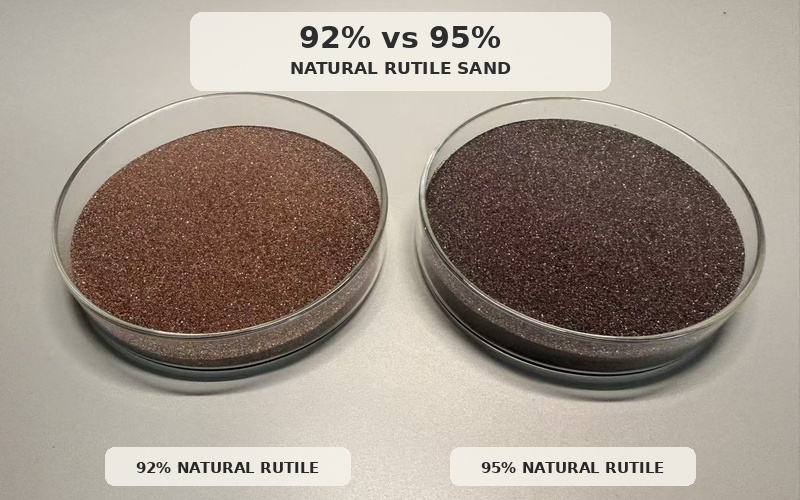
TiO₂ is the primary component of natural rutile sand. For many welding electrode formulations, buyers commonly request rutile sand containing at least 95% TiO₂.
Higher TiO₂ content generally means fewer unwanted mineral impurities. It can also support stable arc performance and proper slag formation when the material is used in a suitable electrode formulation.
However, two rutile products with similar TiO₂ content may still perform differently if their impurity levels or particle-size distributions are not the same. Buyers should therefore avoid selecting a product based only on its TiO₂ percentage.
Why SiO₂ Should Be Controlled
Silicon dioxide is one of the main impurities checked in rutile sand.
The acceptable limit depends on the electrode formulation. Some manufacturers require SiO₂ below 1%, while others can accept a higher level. A typical purchasing specification may allow up to 2.5%.
The important point is not simply whether the SiO₂ value is low, but whether it remains stable between batches. A sudden change in silica content may require the manufacturer to adjust other raw materials in the coating formula.
When comparing quotations, buyers should check whether the SiO₂ value shown on the COA is a typical result or a guaranteed maximum.
Total Iron and Fe₂O₃ Are Not the Same Expression
Iron may be reported on a COA as total iron, marked as TFe or Fe, or as iron oxide, marked as Fe₂O₃.
These figures should not be compared directly without checking the reporting basis. If total iron needs to be expressed as Fe₂O₃, the approximate conversion is:
Fe₂O₃ = Total Fe × 1.43
For example, a total iron result of 0.43% is approximately equivalent to 0.61% Fe₂O₃.
This distinction is important when the buyer’s specification gives a maximum Fe₂O₃ value but the supplier’s laboratory report only shows total iron.
The supplier should clearly explain the testing basis instead of presenting the two values as if they were identical.
Sulfur and Phosphorus Require Attention
Sulfur and phosphorus are usually controlled at relatively low levels in welding-grade rutile sand.
A common requirement may specify:
Sulfur: 0.03% maximum
Phosphorus: 0.03% maximum
These elements should be checked carefully because a result that is exactly equal to the permitted maximum leaves little room for normal batch variation.
For long-term purchasing, it is preferable to select material whose normal test results remain comfortably below the agreed maximum rather than repeatedly sitting at the limit.
A recent report showing a low result is useful, but buyers should also ask whether the supplier can guarantee the same limit for commercial shipments.
How to Evaluate ZrO₂ Content
Natural rutile may contain a certain amount of zirconium dioxide because rutile deposits can occur together with zircon-bearing minerals.
The acceptable ZrO₂ level depends on the customer’s electrode formulation. Some manufacturers may set a maximum of 1.0%, while others can accept 1.5% or more.
As with other impurities, consistency is often more important than achieving the lowest possible number. The buyer should confirm both the typical value and the guaranteed maximum before placing a bulk order.
Understanding +50 Mesh and -200 Mesh
Particle-size descriptions are sometimes misunderstood during international purchasing.
If a specification states:
+50 mesh: 0%
-200 mesh: 20% maximum
“+50 mesh 0%” means that no material should remain above the 50-mesh screen. In other words, the product must pass through the 50-mesh sieve completely.
“-200 mesh 20% maximum” means that no more than 20% of the material may pass through the 200-mesh sieve.
This type of distribution controls both oversized particles and excessive fines.
Oversized particles can cause uneven mixing or coating problems, while too much fine material may affect binder demand, flow behaviour and the consistency of the electrode coating mixture.
A supplier should therefore provide more than a general description such as “fine powder.” Buyers should request actual sieve data showing the retained or passing percentage at the required mesh sizes.
A Typical Purchasing Specification
The following is an example of a specification that may be used when purchasing natural rutile sand for welding electrode production:
| Item | Requirement |
|---|---|
| TiO₂ | 95.0% minimum |
| S | 0.03% maximum |
| P | 0.03% maximum |
| SiO₂ | 2.5% maximum |
| Fe₂O₃ | 2.0% maximum |
| ZrO₂ | 1.5% maximum |
| +50 mesh | 0% |
| -200 mesh | 20% maximum |
This is only an example. Every electrode manufacturer should confirm the limits required by its own formulation and production process.
What Buyers Should Request Before Ordering
Before confirming a bulk order, buyers should request the following information from the supplier:
A recent COA or third-party chemical analysis.
Actual particle-size or sieve-test results.
Confirmation of whether iron is reported as total Fe or Fe₂O₃.
Guaranteed limits for the commercial shipment.
Details of the sampling and pre-shipment inspection procedure.
Packing method and net weight per bag.
A representative sample for laboratory or production testing when necessary.
It is also important to check whether the supplied COA represents the exact grade being offered. A report for a higher or lower grade should not be used without clearly explaining the differences.
Batch Consistency Matters More Than One Good Report
A strong laboratory report is useful, but purchasing decisions should not depend on a single test result.
For regular electrode production, stable supply and batch consistency are essential. Changes in TiO₂, silica, iron or particle-size distribution may affect how the raw material behaves during mixing, extrusion, drying and welding tests.
A reliable supplier should be able to provide pre-shipment inspection, lot-specific documentation and clear communication when natural variations occur.
Hebei Maosheng supplies natural rutile sand for welding electrode and welding consumable manufacturers. Available grades, particle sizes and packing methods can be discussed according to the customer’s formulation and purchasing requirements.
For a COA, particle-size information, sample evaluation or quotation, please contact us directly.