Ilmenite Sand Sample Testing Before Bulk Purchase: A Practical Guide for Welding Electrode Manufactu
Before placing a bulk order for ilmenite sand, welding electrode manufacturers normally need to test a representative sample. A product may meet the basic TiO₂ requirement on paper, but its actual performance can still be affected by particle size distribution, moisture, impurities and batch consistency.
A structured sample-testing process helps buyers identify unsuitable material early, reduce production risks and establish clear quality requirements before commercial cooperation begins.
This guide explains the main points welding electrode manufacturers should check when evaluating an ilmenite sand sample.
Why Sample Testing Is Important
Ilmenite sand is used as a titanium-bearing raw material in welding electrode coatings. Depending on the electrode formulation, it may influence coating preparation, extrusion behavior, slag performance and the appearance of the finished weld.
However, electrode formulations and production equipment vary between manufacturers. Material that works well in one factory may require adjustments in another. For this reason, a Certificate of Analysis should be treated as an important reference, but not as a substitute for actual production testing.
A sample test allows the buyer to confirm whether the proposed material is suitable for the existing formula and manufacturing process before committing to a full container or long-term order.
1. Confirm the Chemical Composition
The first step is to compare the sample’s chemical composition with the buyer’s technical requirements.
TiO₂ content is usually the primary specification, but it should not be the only parameter considered. Buyers may also need to check:
Total iron content
SiO₂
Al₂O₃
MgO
CaO
Phosphorus
Sulfur
Moisture
Ilmenite sand is available in different TiO₂ grades, such as 54%, 58% and 60%. The suitable grade depends on the electrode type, coating formulation, required welding performance and production cost.
A higher TiO₂ content does not automatically mean that the material is the best choice for every formulation. The complete chemical balance and the results of the production trial are more important.
2. Check Particle Size Distribution
Particle size is one of the most important factors when evaluating ilmenite sand for welding electrode production.
A sample should not be judged only by a general description such as “fine powder” or “60 mesh.” Buyers should request a clear particle size specification or sieve analysis.
Important questions include:
What percentage passes the required mesh?
Is there excessive oversize material?
Is the material too fine for the existing formulation?
Is the particle size consistent throughout the sample?
Can the supplier maintain the same sizing for future shipments?
Material that is too coarse may affect mixing uniformity and coating surface quality. Excessive fine particles may influence material flow, binder demand and extrusion behavior.
The buyer should test the sample according to the same sieving method used for routine incoming-material inspection.
3. Inspect Moisture and Material Condition
Moisture can affect storage, weighing accuracy, mixing and handling. Ilmenite sand with excessive moisture may form lumps or become difficult to distribute evenly during coating preparation.
When receiving a sample, buyers should check:
Whether the sample bag is properly sealed
Whether the material contains visible lumps
Whether the powder flows freely
Whether there is any unusual odor or contamination
Whether the actual moisture matches the stated specification
The sample should also be stored in a dry environment before testing. Improper storage after delivery may change its condition and produce misleading results.
4. Examine Color and Physical Appearance
Visual inspection cannot replace laboratory testing, but it is still a useful part of sample evaluation.
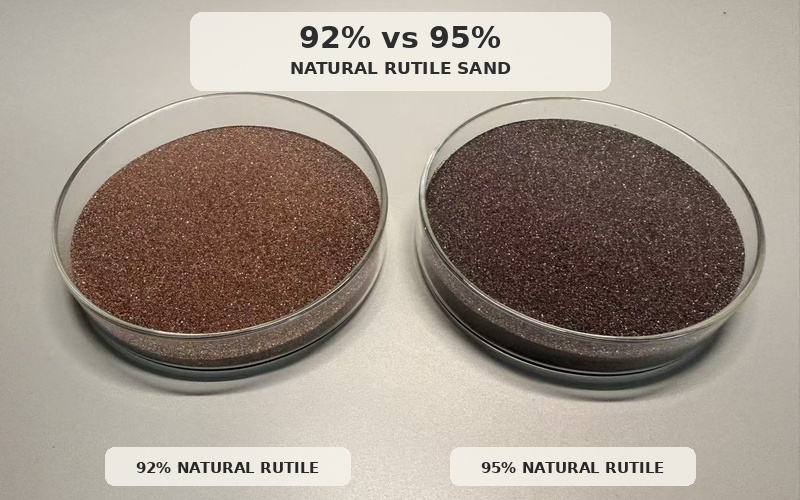
Buyers should observe the material’s color, uniformity, particle appearance and cleanliness. Significant variation within the sample may indicate inconsistent processing or contamination.
It is also useful to retain a portion of the approved sample as a reference. When the first commercial shipment arrives, the buyer can compare its appearance and basic physical condition with the originally approved material.
5. Conduct a Small Production Trial
After laboratory inspection, the sample should be tested in the buyer’s actual electrode formulation.
A small production trial may include:
Raw material weighing and mixing
Binder addition
Coating preparation
Electrode extrusion
Drying or baking
Welding performance testing
During the trial, the manufacturer should observe whether the material mixes evenly and whether any adjustment is required in binder addition, moisture or extrusion parameters.
The finished electrode can then be evaluated for arc stability, slag behavior, slag removal, spatter, bead appearance and other performance requirements determined by the manufacturer.
Production-test records should be kept so that different samples can be compared under similar conditions.
6. Compare the Sample With the Supplier’s COA
The sample test result should be compared with the Certificate of Analysis supplied with the material.
If the buyer approves the sample, both parties should agree on the main commercial quality requirements before placing the order. These may include:
Required TiO₂ grade
Maximum or acceptable impurity levels
Particle size distribution
Moisture limit
Packing method
Inspection method
Acceptable batch tolerance
A common purchasing risk is approving one sample without confirming whether the supplier can reproduce the same quality in commercial quantities.
Buyers should therefore ask whether the sample comes from current production stock and whether future shipments will follow the same specification.
7. Verify Batch-to-Batch Consistency
Successful sample testing is only the first stage of supplier approval. For regular purchasing, batch consistency is equally important.
Changes in chemical composition or particle size may force the electrode manufacturer to adjust its formulation or production parameters. This can increase testing costs and create unnecessary production interruptions.
A reliable supplier should be able to provide a COA for each shipment and maintain the agreed specification across different batches.
For the first commercial order, some buyers may choose a trial quantity before moving to regular container shipments.
Questions to Ask Before Placing a Bulk Order
Before confirming an ilmenite sand order, buyers should ask the supplier:
Is the sample taken from regular production material?
Can the same specification be supplied consistently?
What particle sizes are available?
Is a COA provided with each shipment?
What is the standard packaging?
What quantity can be loaded in one container?
What are the available FOB, CIF or EXW terms?
How long is the normal production and delivery time?
Clear communication at the sample stage helps prevent misunderstandings after the order is placed.
Ilmenite Sand Supply From China
Hebei Maosheng Zirconium Titanium New Material Technology Co., Ltd. supplies natural ilmenite sand for welding materials, titanium processing, metallurgy and other industrial applications.
Available TiO₂ grades may include 54%, 58% and 60%. Please see our Ilmenite Sand 46–60% TiO₂ product page for available grades and supply information.
We can provide product specifications, a Certificate of Analysis, samples and quotations for customer evaluation. Packing and trade terms can be arranged according to order quantity and destination.
Conclusion
Sample testing is an essential step before purchasing ilmenite sand in bulk. Buyers should evaluate chemical composition, particle size, moisture, physical condition and actual production performance instead of relying only on TiO₂ content or price.
Once a sample is approved, the agreed specification should be clearly documented and maintained for future shipments.
If you are looking for ilmenite sand for welding electrode manufacturing or other industrial applications, please contact us with your required TiO₂ content, particle size, quantity and destination port. We will recommend a suitable specification for your evaluation.