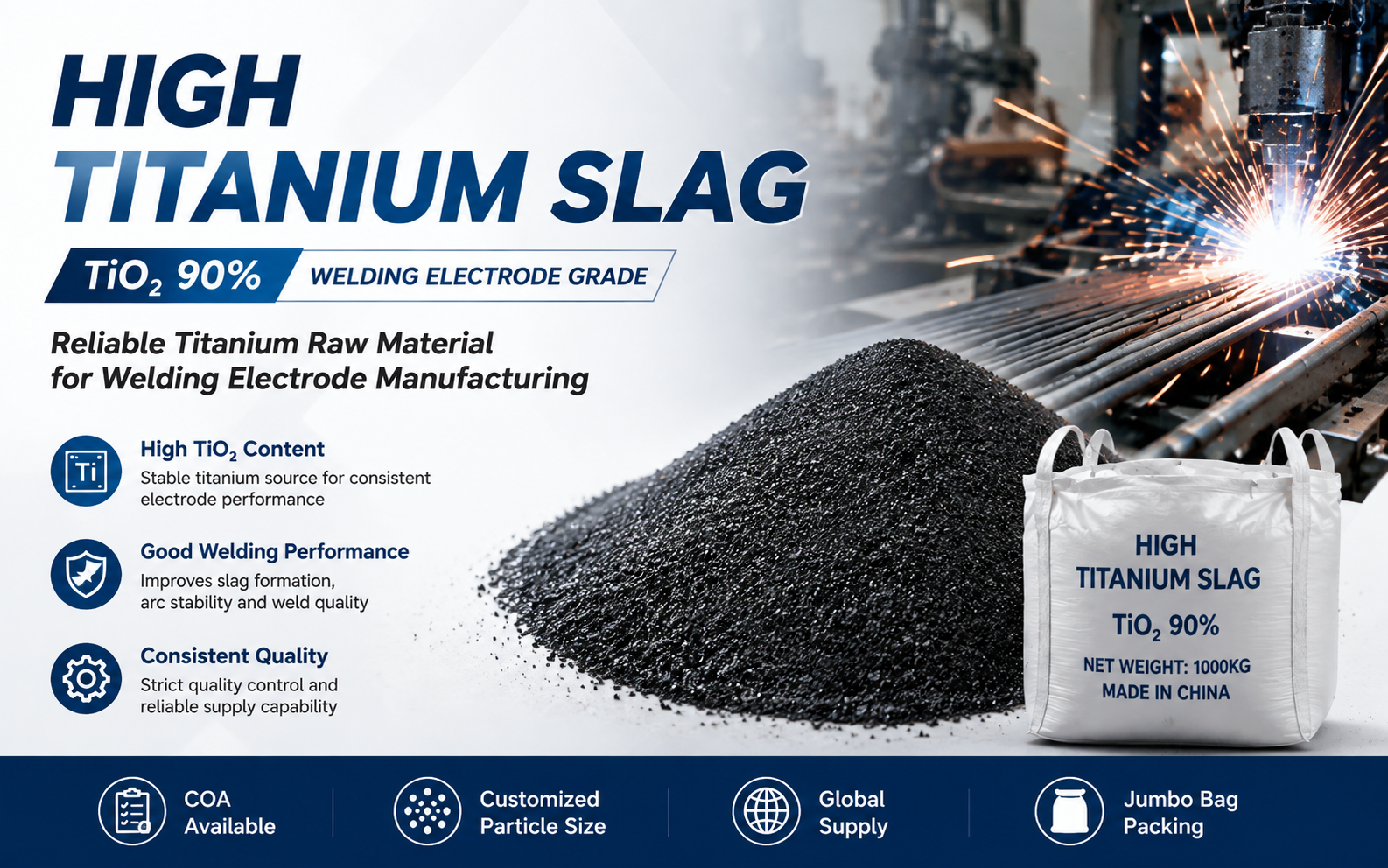
Natural Rutile for Flux-Cored Welding Wire: Key Raw Material Requirements
Natural rutile is an important titanium-bearing raw material used in certain flux-cored welding wire formulations. For welding consumable manufacturers, selecting a suitable rutile grade involves more than checking TiO₂ content alone.
Chemical composition, particle size distribution, impurity control, batch consistency and actual welding performance should all be evaluated before establishing regular supply.
This guide explains the key factors that flux-cored welding wire manufacturers should consider when sourcing natural rutile.
1. Why Is Natural Rutile Used in Flux-Cored Welding Wire?
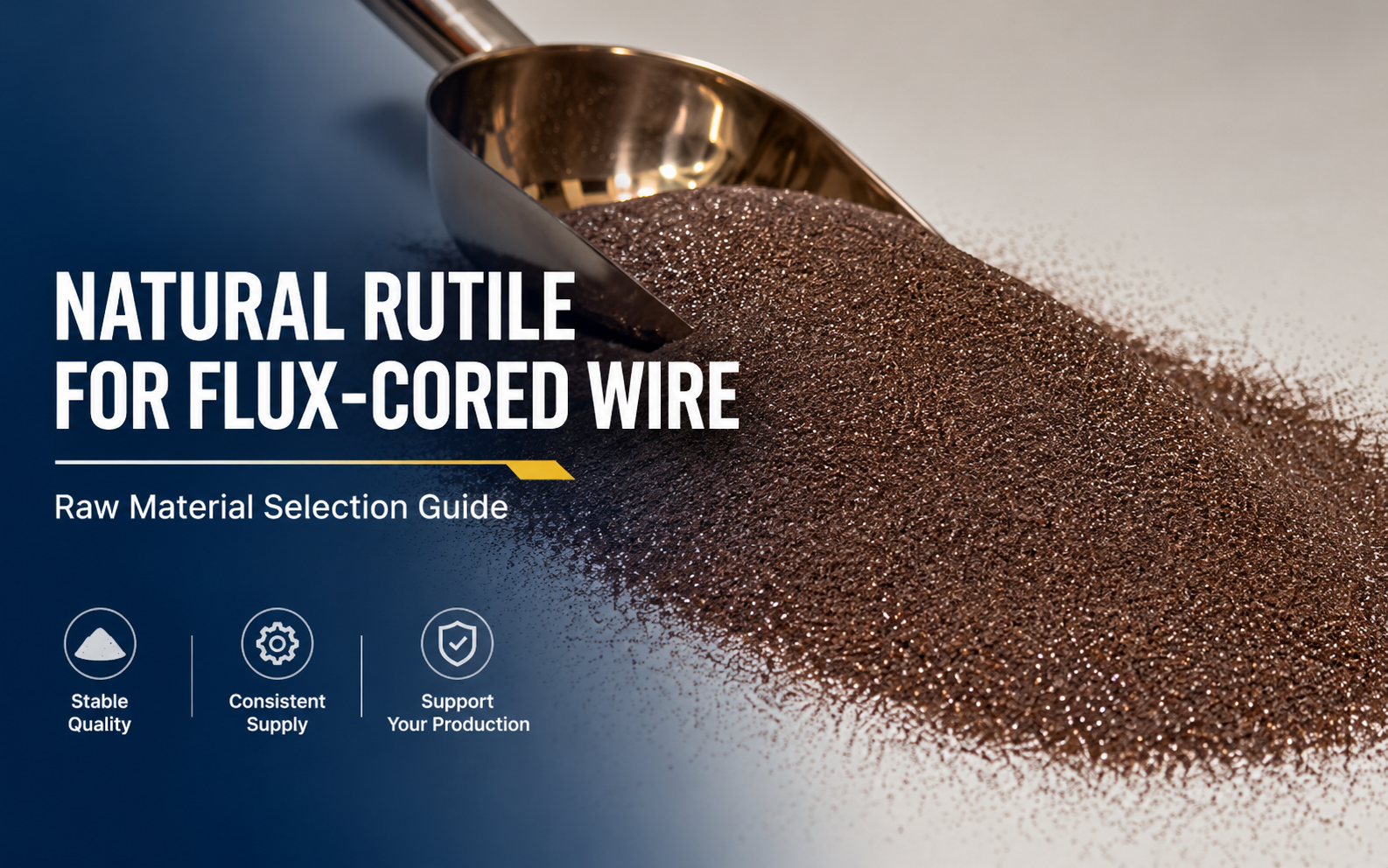
Natural rutile is a naturally occurring mineral with a high titanium dioxide (TiO₂) content. In welding consumable production, rutile-containing formulations can be used as part of the flux system.For more information, see Why Rutile Is Used in E71T1 Flux Cored Wire Production.
Depending on the welding wire formulation, rutile may contribute to slag characteristics, arc behavior and overall welding performance.
However, every flux-cored wire formulation is different. The suitability of a particular natural rutile should therefore be confirmed through laboratory and production testing rather than TiO₂ content alone.
2. TiO₂ Content: 92% or 95% Natural Rutile?
Two commonly supplied grades for welding applications are:
| Grade | Typical TiO₂ Level | Selection Consideration |
|---|---|---|
| Natural Rutile 92% | ≥92% | Suitable for evaluation where the formulation allows a wider impurity range |
| Natural Rutile 95% | ≥95% | Higher TiO₂ grade for manufacturers requiring tighter raw material specifications |
A higher TiO₂ percentage does not automatically mean that a material will perform better in every welding wire formulation.
Flux-cored wire manufacturers should also evaluate SiO₂, Fe compounds, ZrO₂ and other components according to their own formulation and technical requirements.
For this reason, it is advisable to provide your current raw material specification or target chemical limits when requesting a quotation.
3. Particle Size Distribution Is Critical
Particle size is another important purchasing parameter.
Natural rutile that is too coarse or has an unstable particle size distribution may create difficulties during raw material mixing and subsequent production processes. Excessive fine particles may also affect material handling and formulation consistency.
For our welding-grade natural rutile, 60 mesh passing material is available, with finer particle distribution controlled according to customer requirements.
Different flux-cored wire manufacturers may require different particle size ranges. Therefore, particle size should be confirmed before bulk purchasing.
If you currently use a specific mesh specification, please send us your requirement for evaluation.
4. Chemical Composition Should Be Checked Before Purchase
TiO₂ is only one part of a natural rutile specification.
Before approving a new supplier, buyers should review the complete Certificate of Analysis (COA), For a more detailed explanation of COA evaluation, see Rutile Sand COA: What Buyers Should Check Before Placing an Order.including relevant components such as:
TiO₂
SiO₂
Total Fe or iron compounds
ZrO₂
Sulfur and phosphorus where required
Moisture
Particle size distribution
The acceptable limits depend on the manufacturer's flux formulation and welding wire type.
A supplier should be able to provide representative test data before commercial-scale purchasing.
5. Batch Consistency Matters for Welding Consumable Production
For welding consumable manufacturers, stable supply is just as important as the result of a single sample.
A laboratory sample may meet the required specification, but regular production requires consistent chemical composition and particle size from shipment to shipment.
When evaluating a natural rutile supplier, manufacturers should therefore consider:
Raw material source
Processing and screening control
Batch testing procedures
COA availability
Particle size consistency
Packing and moisture protection
Long-term supply capability
Stable raw material quality can reduce the need for frequent formulation adjustments during production.
6. Sample Testing Before Bulk Purchase
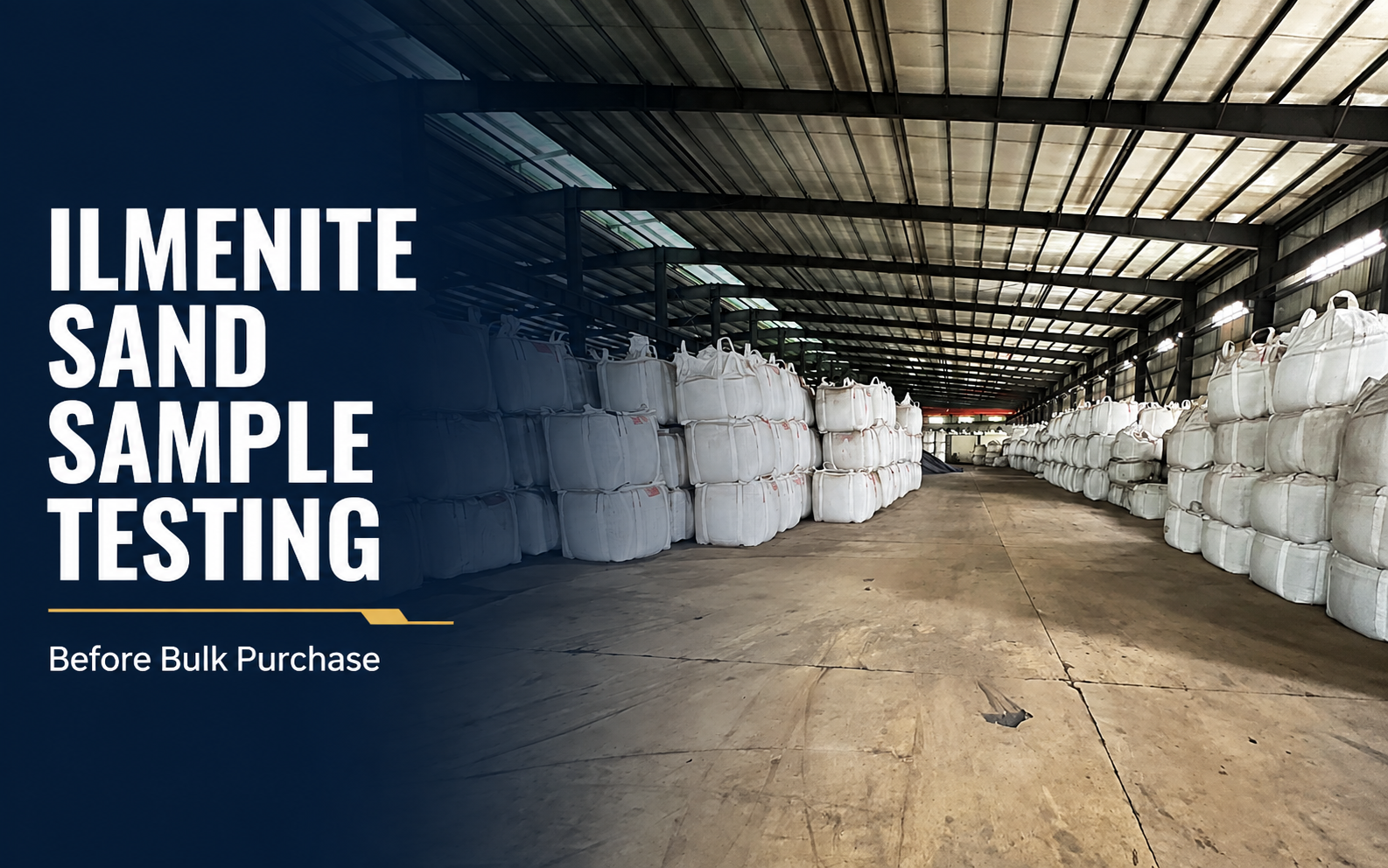
We recommend technical evaluation before placing a large commercial order.You may also read How Welding Electrode Manufacturers Evaluate Rutile Sand Quality Before Purchase for additional guidance on supplier and material evaluation.
A typical qualification process may include:
Step 1: Confirm the required chemical specification and particle size.
Step 2: Review the supplier's COA.
Step 3: Obtain a representative sample.
Step 4: Conduct laboratory formulation and welding tests.
Step 5: If the results are satisfactory, proceed to trial or commercial-scale purchasing.
Actual welding tests are particularly important because two natural rutile materials with similar TiO₂ values may have differences in impurity composition and particle size distribution.
7. Packing and Commercial Supply
For regular export shipments, our natural rutile is typically supplied in:
1 MT jumbo bags
Other requirements can be discussed according to order quantity and destination.
For commercial inquiries, buyers are encouraged to provide:
Required TiO₂ grade
Chemical specification
Particle size or mesh requirement
Trial or monthly quantity
Packing requirement
Destination port
Providing this information allows us to evaluate the requirement and quote a suitable grade more accurately.
8. Natural Rutile Supply for Welding Consumable Manufacturers
HEBEI MAOSHENG ZIRCONIUM TITANIUM NEW MATERIAL TECHNOLOGY CO., LTD. supplies natural rutile for welding consumable applications.
Our current welding-grade options include 92% and 95% TiO₂ natural rutile, with particle size options available according to customer requirements.
For flux-cored welding wire manufacturers evaluating a new rutile source, we can provide:
Product specification
Certificate of Analysis
Particle size information
Samples for technical evaluation
Export packing information
FOB or CIF quotation based on destination
If you currently use natural rutile in flux-cored welding wire production, you can send us your current specification or COA. We can compare the requirements and recommend a suitable grade for testing.
Frequently Asked Questions
Is 95% TiO₂ natural rutile always better than 92%?
Not necessarily. The appropriate grade depends on the flux formulation, impurity limits, particle size requirements and target welding performance. Technical testing is recommended before changing raw materials.
What particle size of natural rutile is suitable for flux-cored welding wire?
There is no single particle size suitable for every manufacturer. Requirements vary according to formulation and production process. We can supply 60 mesh passing material and discuss other particle size requirements.
Can a sample be tested before placing a full-container order?
Yes. Sample evaluation is recommended when qualifying a new natural rutile source.
What information should I provide when requesting a quotation?
Please provide the required TiO₂ grade, chemical specification, particle size, estimated quantity, packing requirement and destination port. If available, sending your current specification or COA is particularly helpful.