60 Mesh vs 80 Mesh Rutile Sand: Particle Size Guide for Welding Electrodes
Natural rutile sand is an important titanium dioxide (TiO₂) raw material used in the production of rutile-type welding electrodes, including E6013 electrodes, and various welding fluxes.
When purchasing natural rutile sand, manufacturers often focus on TiO₂ content, chemical impurities and price. However, particle size distribution is another important factor that deserves careful attention.
Two commonly discussed specifications are 60 mesh and 80 mesh rutile sand. What is the difference between them, and how should welding electrode manufacturers select the appropriate grade?
This guide explains mesh sizes, fine-particle content, sieve analysis and practical purchasing considerations.
1. What Does Mesh Size Mean in Rutile Sand?
Mesh size describes the number of openings per linear inch in a woven sieve screen.
In general, a higher mesh number indicates a smaller sieve opening.
For commonly used ASTM/US standard sieves, approximate opening sizes include:
| Mesh Size | Sieve Opening |
|---|---|
| 50 mesh | 300 μm |
| 60 mesh | 250 μm |
| 80 mesh | 180 μm |
| 100 mesh | 150 μm |
| 120 mesh | 125 μm |
| 140 mesh | 106 μm |
| 160 mesh | 90 μm |
| 180 mesh | 80 μm |
| 200 mesh | 75 μm |
These values are nominal openings for the indicated sieve standard. Actual openings may differ under other sieve standards.
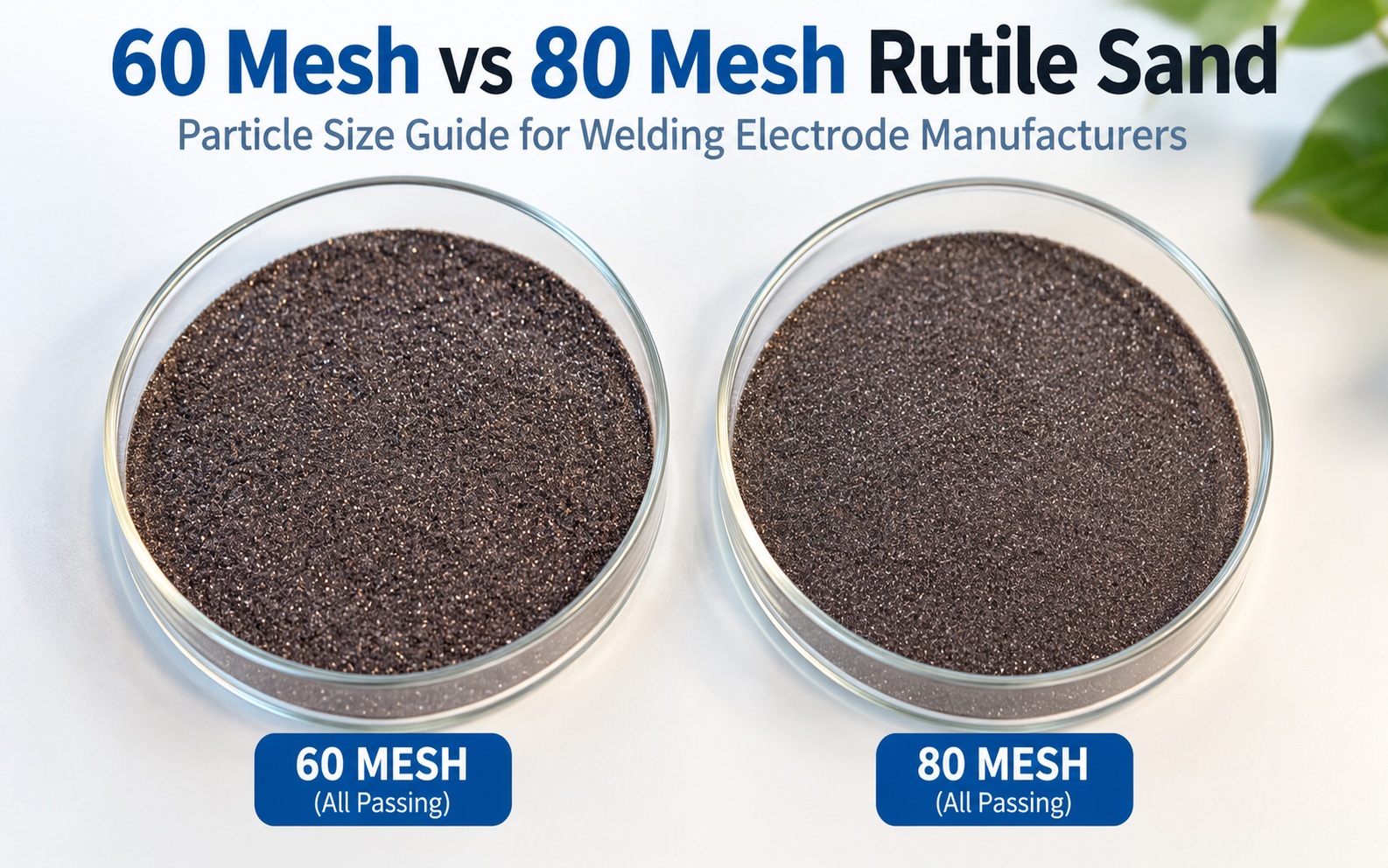
60 mesh all passing means the material passes completely through a sieve with an approximately 250 μm opening.
80 mesh all passing means the material passes completely through a finer sieve with an approximately 180 μm opening.
Therefore, 80 mesh all-passing rutile has a smaller maximum nominal particle size than 60 mesh all-passing rutile.
However, this does not mean every particle in an 80 mesh product has the same diameter.
2. 60 Mesh vs 80 Mesh Rutile Sand: Main Differences
Both grades may be considered for welding electrode production, depending on the manufacturer's formulation and processing equipment.
| Comparison | 60 Mesh Rutile Sand | 80 Mesh Rutile Sand |
|---|---|---|
| Nominal sieve opening | 250 μm | 180 μm |
| Maximum nominal size when all passing | Below 250 μm | Below 180 μm |
| Particle size requirement | Less restrictive | Finer upper-size limit |
| Processing considerations | May require additional screening for finer specifications | Requires finer screening or classification |
| Typical evaluation | Chemical composition and full PSD | Chemical composition and full PSD |
The actual performance of either grade depends on its complete particle size distribution, not simply the mesh designation.
For example, two batches may both pass an 80 mesh sieve but contain significantly different percentages of particles below 75 μm.
This difference may influence material handling, mixing and coating preparation.
3. Why Particle Size Matters in E6013 Welding Electrode Production
Rutile-type welding electrodes use titanium dioxide-containing materials as important components of their flux coatings.
In electrode manufacturing, mineral raw materials must be combined with other ingredients according to the manufacturer's coating formulation.
Particle size distribution can influence several processing characteristics.
Mixing Uniformity
An appropriate particle size distribution can help manufacturers obtain a consistent mineral mixture.
A large proportion of oversized particles may make it more difficult to achieve the desired coating texture.
Coating Preparation
Particle size can influence packing behavior, flow properties and interaction with liquid binders.
Very fine particles have a relatively large surface area and may change the water or binder requirements of a particular formulation.
Manufacturing Consistency
Consistent raw material specifications help manufacturers control batch-to-batch variation.
Nevertheless, the suitability of any rutile grade must be verified through production trials and electrode performance testing.
A finer rutile grade does not automatically produce a better welding electrode. The correct selection depends on the overall coating formulation.
4. Understanding the Importance of -200 Mesh Fines
One specification frequently requested by welding electrode manufacturers is the percentage of material passing a 200 mesh sieve.
A 200 mesh sieve has a nominal opening of approximately 75 μm.
For example:
-200 mesh ≤10% means no more than 10% of the sample mass passes through the 200 mesh sieve.
-200 mesh ≤15% means no more than 15% passes through that sieve.
The percentage of fine particles is important because it describes a part of the distribution that cannot be determined from the maximum particle size alone.
Excessive fines may affect powder flow, dust generation, mixing and binder demand.
However, the optimum fines percentage varies with the customer's production process.
Manufacturers should specify their preferred fines limit and verify it using a representative sieve analysis.
5. Example: Actual Sieve Analysis of 60 Mesh Natural Rutile Sand
To illustrate how particle size distribution can be evaluated, the following table presents a 200 g sieve analysis sample of natural rutile sand.
The material passed completely through the 60 mesh sieve.
| Sieve Fraction | Retained Weight | Percentage |
|---|---|---|
| +60 mesh | 0 g | 0% |
| -60 +80 mesh | 14 g | 7% |
| -80 +100 mesh | 32 g | 16% |
| -100 +120 mesh | 44 g | 22% |
| -120 +140 mesh | 26 g | 13% |
| -140 +160 mesh | 42 g | 21% |
| -160 +180 mesh | 15 g | 7.5% |
| -180 +200 mesh | 17 g | 8.5% |
| -200 mesh | 8 g | 4% |
| Total | 198 g | 99% |
Test notes: The nominal sample mass was 200 g, while the recorded recovered mass was 198 g. The 2 g difference represents an unreconciled 1% mass balance and should not be assigned to a specific particle size fraction.
The recorded results indicate:
All material passed the 60 mesh sieve.
The measured fraction passing 200 mesh was 4% of the initial sample mass.
The majority of the recovered material was distributed between the 80 mesh and 160 mesh fractions.
These results illustrate one sample and should not be interpreted as a guaranteed specification for every production batch.
For commercial orders, particle size requirements should be agreed upon and confirmed using appropriate sampling and testing procedures.
6. What Does D50 = 100–180 μm Mean?
Some buyers specify particle size using D50 rather than mesh alone.
D50 is the median particle size: the diameter below which 50% of the measured particle population falls, according to the measurement method and distribution basis.
When a buyer requests D50 between 100 and 180 μm, the requirement concerns the median particle size, not necessarily the maximum particle size.
For example, a product may have a D50 of 150 μm while still containing both larger and smaller particles.
Therefore, D50 and sieve specifications should not be treated as interchangeable.
Buyers should also specify the test method, since laser diffraction and sieve analysis may describe particle size differently.
7. How to Select the Right Rutile Sand for Welding Electrodes
Before placing an order, welding electrode manufacturers should consider the following parameters.
TiO₂ Content
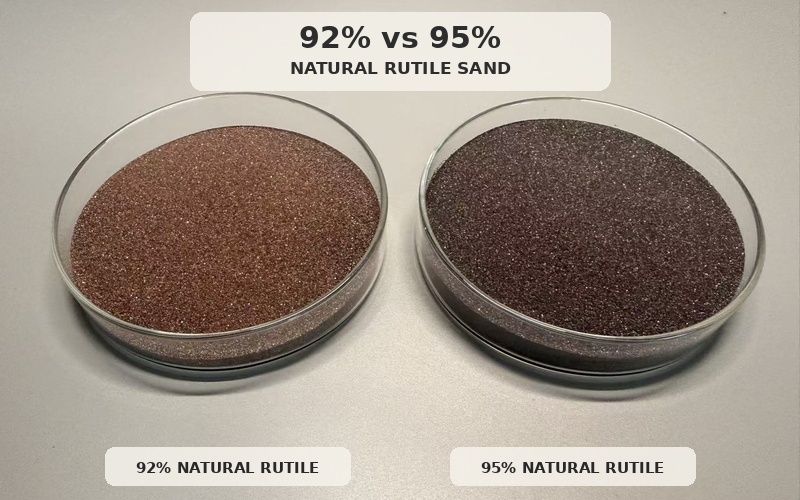
Natural rutile grades with approximately 90%, 92% and 95% TiO₂ may be evaluated depending on product requirements and available supply.
For higher-grade applications, 95% natural rutile is often requested.
Chemical Impurities
Important parameters may include:
SiO₂
Fe₂O₃
ZrO₂
Al₂O₃
Cr₂O₃
V₂O₅
Phosphorus (P)
Sulfur (S)
Additional testing, including uranium (U) and thorium (Th), may be requested where relevant.
Particle Size Distribution
A complete purchasing specification should identify the required maximum particle size, fines limit and any additional sieve fractions.
For example:
TiO₂ ≥95%, 60 mesh all passing, -200 mesh ≤10%.
This is an example of a purchasing specification, not a universal requirement for E6013 electrodes.
Quality Documentation
Buyers may request a Certificate of Analysis (COA), detailed sieve analysis or independent laboratory testing.
The latest available test report should be reviewed before confirming commercial specifications.
8. Natural Rutile Sand Supply from Hebei Maosheng
HEBEI MAOSHENG ZIRCONIUM TITANIUM NEW MATERIAL TECHNOLOGY CO., LTD. supplies natural rutile sand for welding electrode and welding consumable manufacturers.
Our natural rutile feed material originates from Sierra Leone and is processed and screened in China through long-term processing partners.
Our available supply includes:
Natural Rutile Sand 95% TiO₂
Natural Rutile Sand 92% TiO₂, subject to availability
Particle size options including 60 mesh and other sizes upon request
COA and particle size analysis for technical evaluation
Export packing in 1 MT jumbo bags
Shipment arrangements from Qinzhou Port, China
Customers requiring 80 mesh material or a specific D50 range are welcome to provide their detailed specifications for feasibility evaluation.
For more information about our material, visit our Natural Rutile Sand 95% product page.
9. Frequently Asked Questions
Is 80 mesh rutile sand better than 60 mesh for E6013 electrodes?
Not necessarily. An 80 mesh all-passing specification imposes a finer maximum particle size, but the best choice depends on the electrode coating formulation, binder system and production equipment.
Does 60 mesh all passing mean that all particles are 250 μm?
No. It means the material passes through a sieve with a nominal opening of approximately 250 μm. The material may contain a broad range of smaller particles.
Why do buyers specify -200 mesh content?
This requirement limits the proportion of particles finer than approximately 75 μm. It helps buyers control a particular part of the particle size distribution.
Can a 60 mesh rutile sample have a D50 below 180 μm?
Yes. Passing a 60 mesh sieve only limits the upper particle size. A sample may have a considerably smaller median particle size.
Can you provide custom particle size specifications?
We can discuss screening requirements and available particle size options based on the customer's technical specifications and current processing capability. Feasibility and final specifications must be confirmed before order acceptance.
10. Conclusion
Choosing between 60 mesh and 80 mesh natural rutile sand requires more than comparing sieve opening sizes.
For welding electrode manufacturers, TiO₂ content, chemical impurities, fines percentage, particle size distribution and production compatibility should all be considered.
A clear technical specification and representative sieve analysis can help buyers evaluate raw materials more effectively.
Looking for natural rutile sand for E6013 welding electrode production?
Contact HEBEI MAOSHENG ZIRCONIUM TITANIUM NEW MATERIAL TECHNOLOGY CO., LTD. with your required TiO₂ grade, particle size distribution, quantity and destination port.
We welcome technical inquiries and sample evaluation requests from welding electrode manufacturers and mineral raw material importers worldwide.